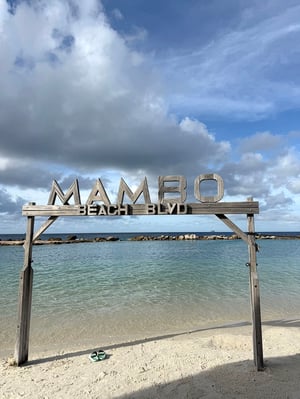
 This morning I decided to go for an early walk toward Mambo Beach. I had some coffee first and then headed out. As I was leaving around 9:00 a.m., I noticed a huge line to get into the World Cafe for breakfast, so I was glad I’d planned to eat after my walk. It was still not too hot, so strolling along the main street was easy, even though it wasn’t very scenic—mostly scrub brush along the way. After about 10 minutes, you reach Mambo Boulevard. You basically turn right and you’re in the Mambo Beach area, which has a large hotel, lots of shops, restaurants, and access to the beach. Parts of the beach were reserved for hotel guests, but a good portion was public. It was a beautiful spot, though packed with beach chairs and palapas, which made it feel a bit crowded. After looking around, I decided to head back to Sunscape for breakfast. By then it was about 9:30 a.m., and there was no one there—so I had easy access to breakfast!
JT: The video below is of the first opportunity for the divers to shoot Lionfish. Lionfish are invasive and have no natural predators in the Caribbean. Thus they are proliferating and decimating the local fish populations. I was more than happy to remove three of these bad actors from the reef. I was talking to one of the divemasters about the Lionfish and she told me that there is a group of divers that comes to Curacao every year with the express purpose of hunting Lionfish. They spend a week and have taken as many as 900 during that time. That's both good news and bad news. They have become expert at cleaning and making sashimi out of their haul. They have also attracted a devoted following of cats that know when it's time to clean them.
Jim got back from diving around noon, and we headed to the Blue Water Grille for lunch. We ran into Catherine and invited her to join us. We learned she’s a 40-year-old lawyer at a medical device company in the Twin Cities. I told her she looks like she’s in her early 30s—she was happy to hear that, and honestly, she really does look that young. Jim was eager to get out of the resort, so we decided to go downtown, and Catherine came along. I ended up playing tour guide, showing them many of the sights I’d discovered the day before.
JT: I must say that I was impressed by how clean and well kept Curacao feels. We have been all over the Caribbean on trips and Curacao stands out for its lack of trash on public streets, the large and well furnished the parks are and good infrastructure. I'm guess that Dutch efficiency plays a big role in that.
For dinner, many in our group were planning to go back to the Blue Water Grille, but since Jim and I had already eaten there at lunch, we decided to try the World Cafe instead. When we arrived, though, we were surprised to find they weren’t serving a regular dinner. Instead, they were hosting their weekly celebration called “Hopi Bon,” which means “very good” in Papiamentu, and offering traditional dishes in an open-air setting right by the water. The food and drinks were plentiful, and everything looked delicious.
Afterwards, there was live entertainment with music and dancers—three men and three women—who performed traditional Dutch dances as well as dances with African influences. Toward the end of the show, they invited people from the audience to learn some of the steps and join in. One member of our group volunteered, and he looked like he was having an absolutely fantastic time.
That evening while we were eating ocean side, Jim clamped his GoPro onto the dive shop dock and did a time lapse of the sunset. It is hard to describe the beauty of these sunsets so this video gives you a little idea of how great they are.