 Susan: Our bus to Berchtesgaden [BERK-tes-gah-den] was scheduled to leave Passau at 7:00 a.m., so we had to have our bags packed and in the lobby by 6:45 a.m. We got breakfast in a brown paper bag and one cup of coffee. It was a bit precarious trying to peel my hard-boiled egg while making sure my coffee cup didn’t spill off my tray on the bus. But I have to say, the big coach bus was an incredibly smooth ride. I am astonished by the places they can navigate, especially on these narrow European roads.
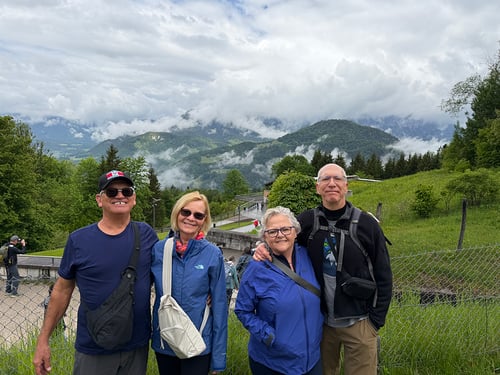
Clay, Jean, Susan Jim in Berchtesgaden
James: We’ve got a long ride ahead of us—two and a half hours until we reach the Austrian Alps and our destination for the day, Hitler’s Eagle’s Nest. It was a sleepy ride with lots of traffic on the roads. We drove through farm fields and small towns every couple of miles or so. I spotted a highway sign for “Bad Füssing,” my favorite town name so far. Germany and Austria have the cleanest, most orderly, best-maintained streets and roads I have ever seen. I saw many maintenance workers sweeping, mowing, and cleaning everywhere we went. It might cost a little more tax money upfront, but what is the value of infrastructure that is as pristine and perfect as possible for its populace? I would argue that it is priceless in how the population values and feels about its own country.
Susan: The other thing I noticed as we drove down the large highways was that there are no billboards. It is great—you just see the lush, green landscape. Our first scheduled stop was the Obersalzberg Documentation Center, which is a learning and memorial site about the Nazi era, located in the former Führer’s Restricted Area of Obersalzberg in Berchtesgaden. It connects local history with the broader history of National Socialism.
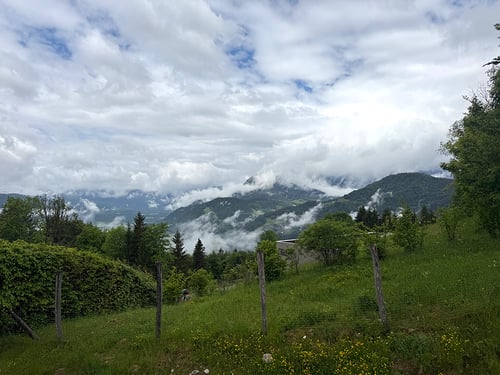 James: After a while we first started to see hills in the distance, and then the Alps appeared. They are the real deal—huge, with snow-covered peaks and cloud-shrouded tops. We eventually turned off our east–west highway and headed south. We drove through winding mountain roads until we came to Obersalzberg, where the Nazi hierarchy had their center of power. Hitler fell in love with this lovely mountain village, so much so that he eventually forced out and displaced all of the residents so that he and his inner circle and their families could take over. These residents included a Jewish scientist who was the inventor of aspirin. Many farm families who had been on the land for several generations were forced to leave. One man who refused to move was told he had to be out of his house in two days. He and his family had no choice. They vacated, and the next day the house was blown up and then burned.
The Obersalzberg Documentation Center is a wonderful museum that tells many of these stories through a film, exhibits, and audio reminiscences. Unfortunately, we only had about an hour to go through everything before our lunch reservation in the on-site restaurant. So we decided to quickly tour some of the bunkers that had been tunneled into the mountain for the protection of the families. One of the tunnels is almost a mile long. They were equipped with all the amenities and comforts that any family could need to survive an onslaught. The bunkers were built initially with contract labor, but Hitler insisted that the whole project be completed in a year, so ultimately it fell to forced labor to complete it. They worked 24 hours a day throughout the seasons to get it done.
Susan: We had lunch at the documentation center. We were required to tell them what we wanted for lunch two days prior so they could have everything ready. I could not remember what I ordered, so I chose the cheese dumplings with salad. The salad was great, but the cheese dumplings were not so good. They were incredibly dry. I expected moist, cheesy dumplings, but no.
This was also the last time we would all be together. Two members of our group were leaving after the Eagle's Nest tour to go on another Road Scholar trip. Out bus literally dropped them at the train station. So Franz insisted we had to do a final photo of the entire group.
After lunch, Franz gave us our tickets to board a bus to take us to the Eagle’s Nest. They have a very organized system to get people up to the top of the mountain. Only their special buses are allowed on the small roads, and the buses are timed so the ones going down have to pull over in a specific location so the ones going up can get through. You must have a specific time on your ticket, and they only sell as many tickets as there are seats on the bus, so you have to be sure you are on your correct bus. The elevation gain between the base, where the documentation center is, and where the buses take you is about 3,000 feet. Then you enter a tunnel in the side of the mountain to take a gold elevator to the Eagle’s Nest that fits about 30 people. We were packed in there!
James: Of course, Hitler’s ultimate crown jewel was his “Eagle’s Nest.” It was to be built on the very pinnacle of the mountain—an insane and nearly impossible task. First of all, a road would need to be constructed. It would require thousands of man-hours blasting rock and manually removing debris to accomplish the feat. He also had an almost mile-long elevator constructed to whisk him to the top.
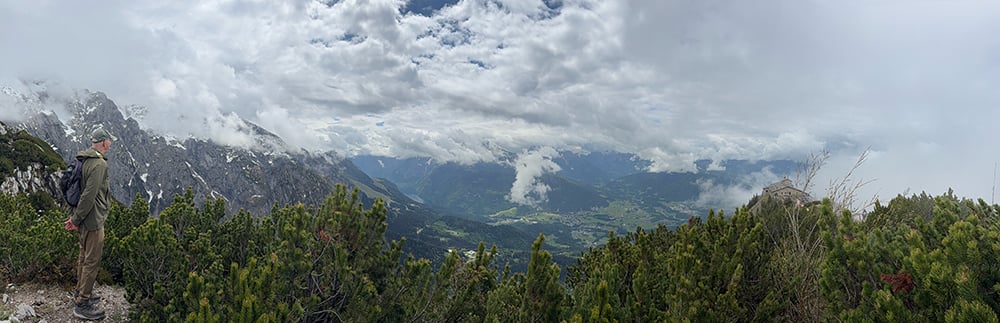
The Eagle’s Nest had a spectacular view of the surrounding mountains. It was built not so much as a residence, but more as a showcase. Hitler used it to impress visiting dignitaries. Ironically, he was afraid of heights, so he rarely visited. His girlfriend, Eva Braun, however, loved it.
It was thought that the compound and Eagle’s Nest were impregnable. However in 1945 dozens of British bombers attacked and flattened the Eagles Nest and the homes. Allied troops arrived and looted the place stripping everything for souvenirs. Hitler and Eva Braun committed suicide before they could be captured. The town was wildly popular with Hitler’s followers before and during the war. Admirers would flock there just to get a glimpse of the Führer. After the war, a lot of those people still came to pay tribute to him and curious tourists came in droves.
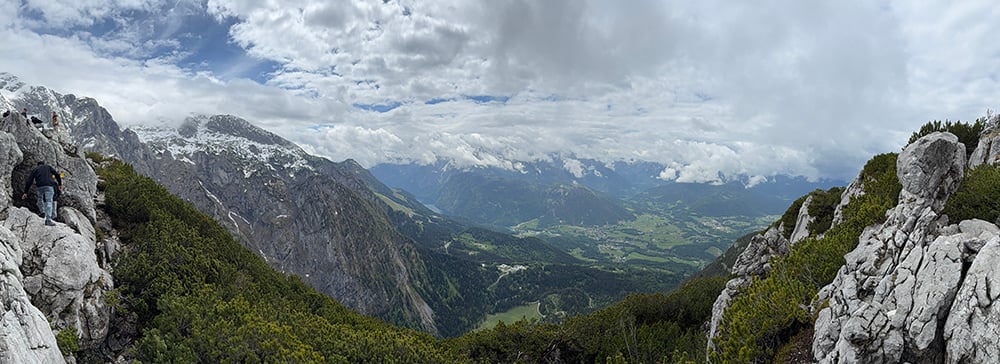
There is of course no more Eagle’s Nest. In its place is now a restaurant and many scenic overlooks at the top. There are shuttle buses to take visitors up. We spent about an hour on the mountain top before it was time to go.
Susan: The views from the top were spectacular! We were at about 6300 feet so birds were flying right around us. There were clouds around us but then the sun came out! So beautiful — then the fog moved in again.
I was surprised how many times the fog lifted and then came back in just during the short time we were there. But I guess it was just the clouds passing through. Plus it rained a little while we were there. But we had rain coats so we were fine.
 James: We boarded our bus for the final leg of our trip to Münich. It was a long, slow ride which included a wrong turn. We arrived about 6:30 and had a late dinner in the adjacent Asian restaurant. Decent food and fun conversations on our last night of our journey.